
How to Search the Tupelo Court Docket
Start a Tupelo docket search with the court named on the citation itself. Tupelo Municipal Court handles city ordinances, speeding tickets, and code violations. The city's payment page can process a fine for those matters. But it is not a full case archive. The strongest identifier is the exact citation or docket number printed on the notice. Check the paper carefully. The notice may point to Lee County Justice Court instead. Take the matter there rather than forcing a city lookup. A docket search in the wrong court wastes a trip. It can return nothing at all.
- Read the Tupelo citation or notice for the court name, citation number, and scheduled date.
- Open the official Tupelo Municipal Court page to confirm that the matter is a city court case.
- Use the city’s payment route only when payment is permitted for that particular Tupelo citation.
- Call the Tupelo municipal clerk at 662-841-6516 for a current setting, docket entry, disposition, or copy procedure.
- For a Lee County Justice, Circuit, County, Youth, or Chancery case, retain the lower citation and use the responsible county clerk or court system.
Have the violation date ready, and know what you need from the file. A hearing setting, a docket entry, or a final result each count as different items. A name helps the clerk find a Tupelo case. The case number is the stronger tool. Keep one more distinction in mind. A payment confirmation is not a Tupelo court disposition. So ask the clerk which paper actually proves the outcome.
Tupelo Trial Docket Archive
The city's municipal court page posts links to old trial and arraignment docket PDFs. These Tupelo reports are handy for two things. One is learning the city's local labels. The other is finding a dated public schedule. They are not a promise. The setting, fine amount, judge assignment, or layout in a historical Tupelo docket may have no bearing on a case set today. An archive label or trial-by-judge setting on an old sheet carries no force for a current matter.
Treat the archive as a lead, not an answer. Match the report date, citation number, and docket number against the Tupelo notice. Then confirm live status with the municipal clerk. A court date may have moved, been continued, or dropped from the city list since the PDF was posted. Only the court controls the present Tupelo setting.
Note: Save the report date and court label whenever you pull a Tupelo PDF. Both details help the clerk tell an archived entry apart from a current case.
The Tupelo Municipal Court
The official Tupelo Municipal Court page lists the city court at 316 Court Street. The court phone there is 662-841-6516. City ordinances, speeding tickets, and code violations all land here. Jay Weir and Willie C. Allen appear as presiding judges. The judge on any particular Tupelo setting should still be confirmed through the live court record or the clerk. Keep this court separate from the Lee County Justice Center at 200 West Jefferson Street.
That split matters more than people expect. Tupelo municipal staff keep the city court materials. The Lee County Circuit Clerk holds the Circuit, County, and Youth Court records. One Tupelo resident can have two unrelated cases sitting in two different offices. The address on the citation is the clue that routes you correctly, not a home address or a broad county search.
Tupelo Municipal Court
316 Court Street
Tupelo, MS 38804
662-841-6516
City ordinance, traffic, and code-violation case routing.
Tupelo Docket Report Fields
Older Tupelo docket reports pack a lot into a single line. One entry may list a citation number. It may also carry a docket number, the court date, the setting, and the location. The statute or offense can appear, plus the violation date, the fine, and the costs. Beyond that come the officer or agency, the police case number, and the plea. The bond appears too, along with whether the amount is paid or due. Attorney and time fields round it out. Every field answers a different question. No single one gives you the whole case file.
| Tupelo field | Use when checking a record |
|---|---|
| Citation or docket number | Links a Tupelo notice to the correct city court file. |
| Court date and time | Shows a listed setting, which still needs current confirmation. |
| Plea or paid status | Describes an entry, not a substitute for a signed order or clerk confirmation. |
| Fine and costs | Shows fields in an old report, not a current universal Tupelo amount. |
A Tupelo court record can hold filed material that no PDF shows. So ask the city clerk for the exact docket entries or order you need. A matching name alone proves nothing.
Tupelo Court Dates and Settings
Check any Tupelo court date against the notice the city sent you. Then confirm it with the municipal clerk. Historical Tupelo PDFs separate trial dockets from arraignment dockets, but that label is only a starting point. A continuance can change things fast. So can a payment instruction or a new order. The city lists Tupelo office hours of 8:00 a.m. to 4:30 p.m., though those hours are not a published schedule of hearings.
| Date | The scheduled Tupelo appearance date shown on the citation or current clerk record. |
|---|---|
| Time | A listed docket time or setting time, verified before appearing. |
| Location | Tupelo Municipal Court at 316 Court Street when the notice identifies the city court. |
| Judge | The presiding judge shown in the current Tupelo record, not inferred from an archived report. |
| Setting type | Arraignment, trial, or another city-court setting identified by the notice or clerk. |
If the status is unclear, call before you travel. A calendar line can be incomplete or stale, and the Tupelo clerk can tell you whether the city court still expects an appearance.
Tupelo Payment and Docket
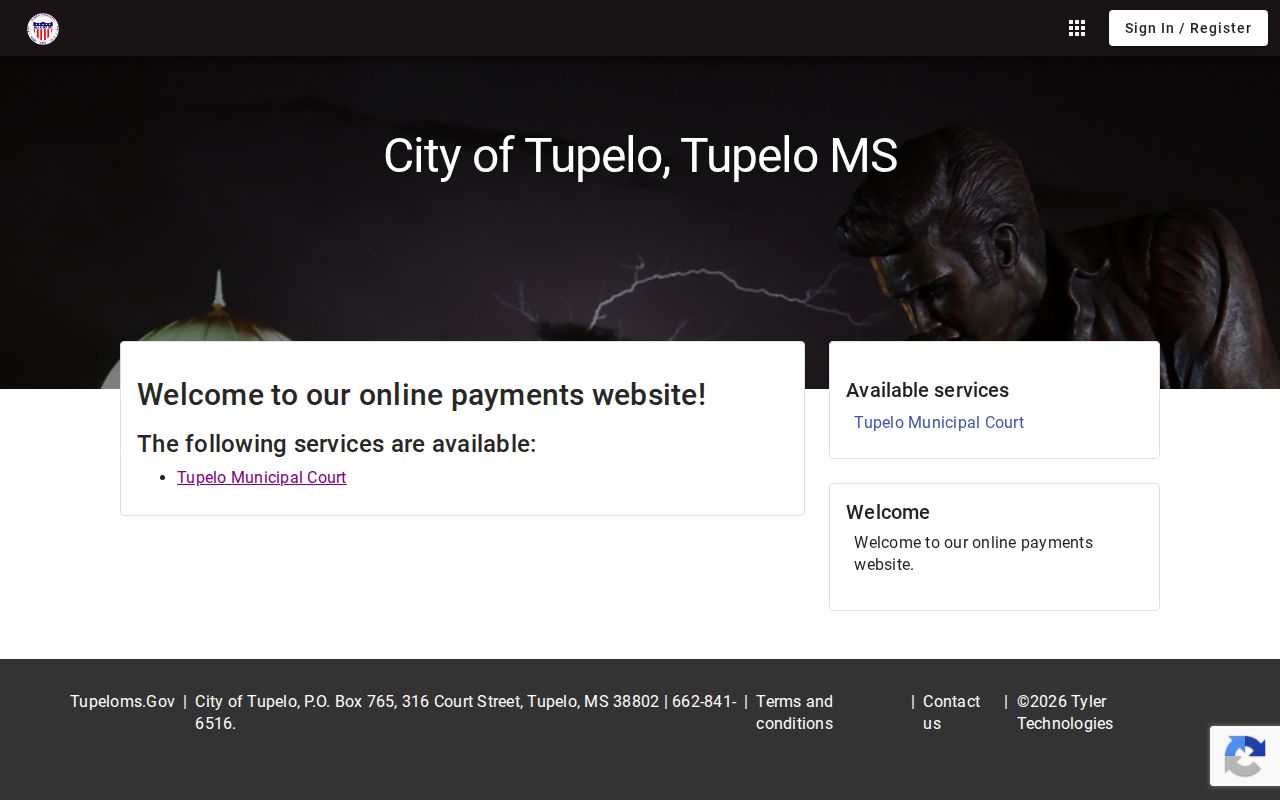
Paying a Tupelo Municipal Court fine online means using Tyler Municipal Online Payments. The Tyler page names the city court and takes payments. That is about all it does. It is not a full Tupelo court docket search. It is not a document archive. And it is not proof that one payment cleared every court requirement tied to the citation. So confirm with the court that payment is even allowed before you send money.
Each document answers one question. A receipt proves you paid. A Tupelo docket entry shows the court date and what the clerk entered that day. A signed order or certified disposition is a third thing entirely. Tell the Tupelo clerk exactly which of these you need. Ask for "a docket printout" versus "a disposition" versus "a certified copy." That one word saves you a trip back for the wrong city document.
See the official Tupelo payment landing page before using its payment function.
Tupelo Traffic Tickets
A traffic ticket written by Tupelo police belongs to Tupelo Municipal Court at the start. Read the paper first. The citation number, court name, and date on it set the next move. Payment helps only if the court allows it for that offense. The notice may demand a hearing, a plea, a trial, or a written request. If it does, call the municipal clerk. Do not assume the payment page is the whole Tupelo case record.
County tickets travel a different road. Lee County Justice Court runs its own office. It keeps its own court times, and the Sheriff side answers some traffic questions. For the full county picture, see Lee County traffic court records. The rule for a Tupelo driver is simple. Follow whichever court is named on the paper you actually hold.
Tupelo Court Street Routing
Several court routes run through Tupelo, and none of them merge. A municipal notice belongs at the city court on 316 Court Street. A Lee Circuit, County, or Youth cause goes to the Justice Center. There it belongs with the Circuit Clerk. Justice Court keeps its own office down the hall from everyone else. Chancery matters stay with the Chancery Clerk and the First Chancery system. Sharing a zip code does not make these one database.
Before calling about a county case, gather the details. Bring the court name and the cause number. Add the filing year and the specific item you want. PAMEC offers a subscriber layer for participating trial-court files. Courthouse electronic access is free during regular hours. Those county channels can reach a Tupelo-origin case filed above the city level. They still cannot replace the Tupelo municipal clerk for city business.
The official Tupelo Municipal Court page identifies the city court’s purpose, contact, and historical docket links.

Where Tupelo Cases End Up
Tupelo Municipal Court covers the city layer and only that layer. Anything appealed or filed in Circuit, County, Justice, Chancery, or Youth Court lives elsewhere. It stays with the receiving court instead. The Circuit Clerk holds Circuit, County, and Youth files. The Chancery Clerk holds the Chancery files. A city ticket does not turn into a Circuit Clerk record. Its origin in Tupelo does not change that.
Docket flow: Tupelo Municipal Court › Lee County Courts › Lee County Circuit Court
An appeal out of Tupelo municipal court comes with a new identity. Ask the city clerk which court received it and what cause number it carries. Keep the original citation too, and hand both numbers to the receiving clerk, who can then find the later docket without guessing.
Tupelo PDF Status Limits
Archive reports throw around words like paid, due, bond, plea, trial docket, and no docket. Treat them as leads, not answers. A paid field is not a judgment. A plea field may not state the final legal disposition. A trial docket entry is not proof the hearing ever happened. Tupelo PDFs help you learn the local record fields. Even so, the current Tupelo court docket and the signed records control.
When an archive result clashes with a notice, ask the clerk. Find out whether the case was continued, settled, closed, transferred, or restricted. Give the cause or citation number, the court date, and the record type. That narrow request guards against a false match. It also lets Tupelo staff pull the right city file.
Note: an empty Tupelo online result is not proof. It can mean an archive limit, a changed number, a restriction, or a different court. It does not prove the case never existed.
Tupelo Citation Cross-References
A Tupelo municipal citation is often the first thread in a longer record trail. City staff may say the case was appealed or routed to a county court. If so, get the receiving court and its new cause number. Write both down. Keep the Tupelo citation, docket number, and court date alongside the new reference. With the two numbers in hand, each clerk can search the slice of the case it maintains. No one has to guess from a party name.
The same cross-reference trick works when an archived city PDF shows no current result. The city clerk confirms the municipal entry. The receiving Lee County clerk confirms the later county case. A payment receipt cannot bridge the two courts. That link has to come from the Tupelo case information. It can also come from the clerk's current routing instructions.
Public Access to Tupelo Court Records
Mississippi's public-record rules open most Tupelo municipal files to anyone who asks. Open is not the same as online, though. Some records stay redacted or out of public view. Youth matters, sealed files, and personal data need extra care from the city clerk. Other restricted material does too. When you make a request, be specific. Give the Tupelo citation or docket number, the date range, and the document you want. The clerk can then tell you the procedure and the copy fee. The clerk can also say whether any part of the record is protected from release.
Key Rules:
Mississippi Public Records Act, Miss. Code §§25-61-1 through 25-61-19 recognizes public access subject to lawful procedures, cost, time, place, and method.
Miss. Code §25-61-5 supports release of reasonably segregable nonexempt material after redaction.
MEC Administrative Procedures, Section 7 describes read-only public electronic access and courthouse access for covered court systems.
Ask for something concrete. A docket entry, a disposition, or a specific order works far better than a broad name-only report. Tupelo staff can route a city request to the right office, while a county court request belongs with the clerk who holds that separate case file.